fastlogging-rs: High-Performance Logging for many different Programming Languages
Logging is often the hidden bottleneck in your application.
Every log.info(...) call can block your hot path, serialize your threads, and slow down your I/O-bound workloads.
That’s why I created fastlogging-rs: a Rust-powered logging framework that is extremely fast, thread-safe,
and available with a similar API in 8 different programming languages.
My first release, 0.8.1, is available with the following features:
- Initial release of the Rust core (
fastloggingcrate) with bindings for Python, C, C++, Go, Java (FFM and JNI) and C# - Non-blocking, asynchronous logging — writers run in background threads
- Optional file rotation and compression
- Optional AES encryption for network logging
- Configuration via API or configuration file (JSON, XML, YAML)
- Automatic forwarding of log messages from sub processes to the main process
Why fastlogging-rs?
Because speed matters…
🚀 Significant Performance Improvements
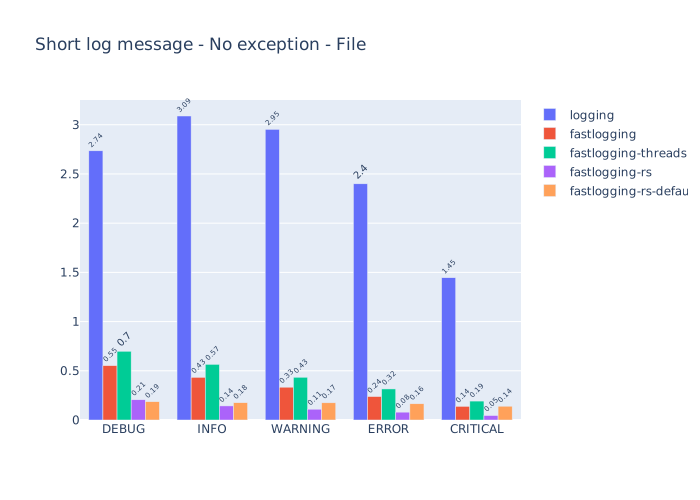
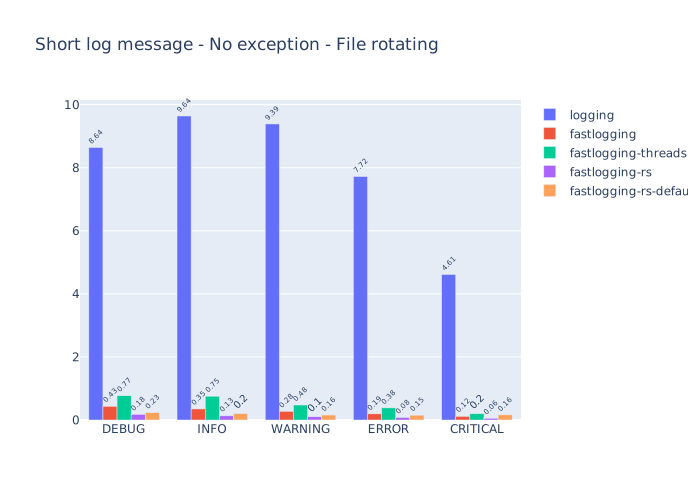
Compared to Python’s built-in logging module:
- Writing to a file is up to 147× faster
- Rotating file logging is up to 207× faster
- Even compared to Apache Log4j, fastlogging-rs is up to 9× faster
When your application logs millions of messages, these speedups can turn minutes into seconds.
Benchmarks results for writing to a file
🌍 One Framework, 8 Languages
fastlogging-rs is written in Rust and comes with thin wrappers for your favorite programming language. All bindings share a similar API,
so you can use the same logging concepts across your whole stack:
| Language | Binding | Layer |
|---|---|---|
| Rust | fastlogging |
Native core |
| Python | pyfastlogging |
pyo3 (>= 3.10) |
| C | cfastlogging |
FFI (cbindgen header) |
| C++ | cxxfastlogging |
type-safe cxx bridge |
| C++ | cppfastlogging |
C++17 RAII over the C ABI |
| Go | gofastlogging |
cgo wrapper |
| Java | jfastlogging-ffm |
Foreign Function & Memory API |
| Java | jfastlogging-jni |
Java Native Interface |
| C# | csharpfastlogging |
P/Invoke |
⚡ Non-Blocking Architecture
Logging calls are non-blocking: each call performs a cheap level check (a single integer comparison, no lock)
and hands the message to a channel. A background LoggingThread drains that channel and dispatches to each
writer’s own thread. The speed of your writers never slows down your application — as long as the queue
doesn’t run full.
🔧 Rich Feature Set
- Thread-safe logging calls
- Multiple writers (sinks) per logger: console, file, network, syslog, callback
- Optional file rotation and compression
- Optional AES encryption for network logging
- Configuration via API or configuration file (JSON, XML, YAML)
- Automatic forwarding of log messages from sub processes to the main process
Installation
Rust
cargo add fastlogging
Python
pip install pyfastlogging
Usage Examples
Rust
use fastlogging::{logging_new_default, LoggingError};

fn main() -> Result<(), LoggingError> {
    let mut log = logging_new_default()?;
    log.info("Hello, fastlogging!")?;
    log.shutdown(false)?;
    Ok(())
}
Python
from fastlogging import Logging

log = Logging()
log.info("Hello, fastlogging!")
log.shutdown(False)
Python with a colored console writer
from pyfastlogging import TRACE, Logging, ConsoleWriterConfig

logger = Logging(
    TRACE,
    "main",
    [ConsoleWriterConfig(TRACE, True)],
)
logger.trace("Trace Message")
logger.debug("Debug Message")
logger.info("Info Message")
logger.shutdown()
Benchmark Results
Writing to a file
| Framework | Time |
|---|---|
| Python logging | 29.37s |
| log4j | 1.48s |
| fastlogging-rs | 0.2s |
Rotating file logging
| Framework | Time |
|---|---|
| Python logging | 35.24s |
| log4j | 1.56s |
| fastlogging-rs | 0.17s |
For detailed benchmark data and methodology, see the benchmark documentation:
https://github.com/brmmm3/fastlogging-rs/blob/master/docs/benchmarks/index.html
You can also explore the full benchmark results with interactive charts and tables:
https://brmmm3.github.io/fastlogging-rs/
Get Started
If your application spends time logging, fastlogging-rs can provide substantial performance improvements with minimal code changes — in whichever language you happen to be writing.
The API is intentionally familiar, making migration from logging, log4j, or your current framework
straightforward while unlocking significantly faster execution.
Source code, documentation, and issue tracker:
https://github.com/brmmm3/fastlogging-rs
Licensed under the MIT or Apache-2.0 License.