layout: post title: scandir-rs tagline: Blazing-fast directory traversal for Python — up to 70× faster than os.walk. date: 2026-06-01 08:40:00 +0100 categories: posts —————–
scandir-rs: High-Performance Directory Traversal for Python
File system traversal is often a hidden bottleneck.
Whether you’re indexing files, collecting statistics, searching large directory trees, or building developer tools, performance matters.
That’s why I created scandir-rs: a Rust-powered Python library designed to be a drop-in replacement for os.walk() and os.scandir(),
while delivering dramatically better performance and additional functionality.
A new version (2.9.9) is available with following changes compared to the version I’ve introduced here the last time (2.7.1):
- Add support for Python 3.13 and 3.14
- Add support for MacOS on ARM64
- Add support for Linux on PPC64 and S390
- Add SSE builds (for older CPUs which have no AVX) for Linux and Windows
- Add optional argument
follow_links. - Changed
skip_hiddento false by default
Why scandir-rs?
Because speed matters…
🚀 Significant Performance Improvements
Compared to Python’s built-in implementations:
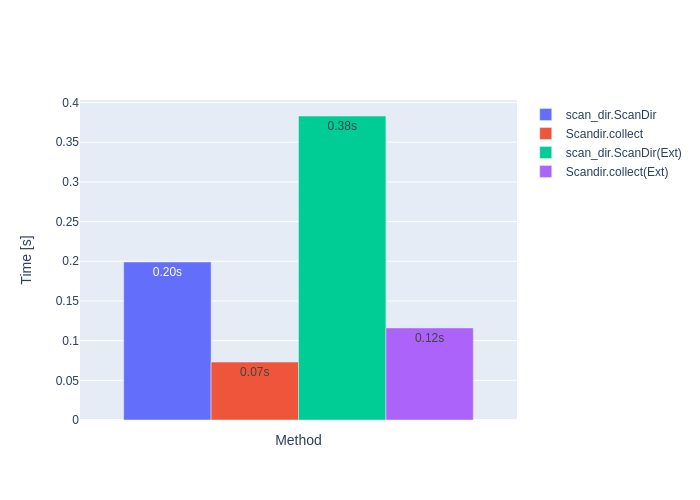
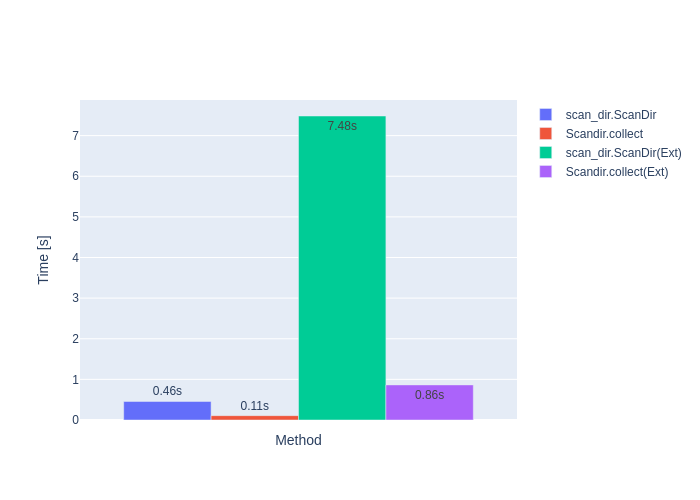
- Walk is up to 13× faster on Linux
- Walk is up to 70× faster on Windows
- Scandir is up to 6.5× faster on both Linux and Windows
When processing millions of files, these speedups can turn minutes into seconds.
Benchmarks results for running scandir in linux-5.9 folder
🔍 Richer Metadata
Beyond the standard os.walk() and os.scandir() APIs, scandir-rs can return:
- Extended file metadata
- Hardlink detection
- Additional file type classification
- Error collection without interrupting traversal
⚡ Background Processing
Long-running scans can run asynchronously in the background, allowing your application to process results while scanning is still in progress.
Installation
pip install scandir-rs
Usage Examples
Directory Statistics
Get fast statistics for an entire directory tree:
import scandir_rs as scandir

print(scandir.Count("/usr").collect())
Extended Statistics
Include additional metadata and hardlink detection:
import scandir_rs as scandir

print(
    scandir.Count(
        "/usr",
        return_type=scandir.ReturnType.Ext
    ).collect()
)
Background Scanning
Process results while scanning continues in the background:
import scandir_rs as scandir

counter = scandir.Count("/usr")

with counter:
    while counter.busy:
        results = counter.results()
        # Process intermediate results

# Final results as JSON
results = counter.to_json()
Faster os.walk()
A familiar interface with significantly better performance:
import scandir_rs as scandir

for root, dirs, files in scandir.Walk("/usr"):
    # Process files
Extended Walk Information
Retrieve additional file categories and error information:
import scandir_rs as scandir

for root, dirs, files, symlinks, other, errors in scandir.Walk(
    "/usr",
    return_type=scandir.ReturnType.Ext
):
    # Process files
On Unix systems, other includes special file types such as pipes and devices.
Faster os.scandir()
Collect all entries at once:
import scandir_rs as scandir

entries, errors = scandir.Scandir("/usr").collect()
Or iterate lazily:
import scandir_rs as scandir

for entry in scandir.Scandir("/usr"):
    # Process entry
Extended Metadata
Request detailed information for each directory entry:
import scandir_rs as scandir

for entry in scandir.Scandir(
    "/usr",
    return_type=scandir.ReturnType.Ext
):
    # Process entry
Entries are returned as DirEntryExt objects. Errors are reported as tuples containing:
(relative_path, error_message)
allowing scans to continue even when individual files cannot be accessed.
Benchmark Results
Walk Performance
| Operation | Linux | Windows |
|---|---|---|
Walk vs os.walk |
Up to 13× faster | Up to 70× faster |
Scandir Performance
| Operation | Linux | Windows |
|---|---|---|
Scandir vs os.scandir |
Up to 6.5× faster | Up to 6.5× faster |
For detailed benchmark data and methodology, see the benchmark documentation:
https://github.com/brmmm3/scandir-rs/blob/master/pyscandir/doc/benchmarks.md
Get Started
If your application spends time traversing large directory trees, scandir-rs can provide substantial performance improvements with minimal code changes.
The API is intentionally familiar, making migration from os.walk() and os.scandir() straightforward
while unlocking additional capabilities and significantly faster execution.
Source code, documentation, and issue tracker:
https://github.com/brmmm3/scandir-rs
Licensed under the MIT License.